How many people make a company?
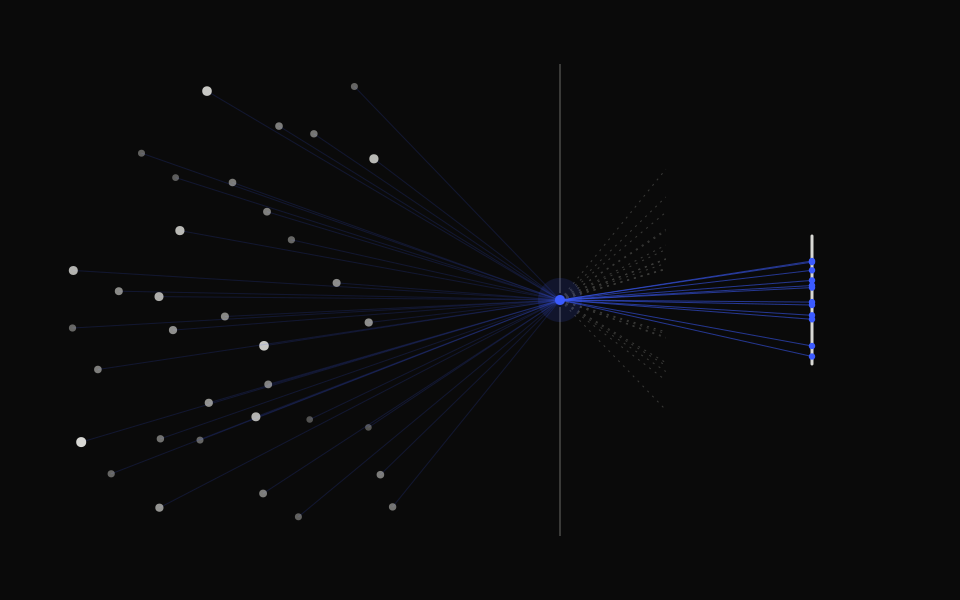
It is one of the most reasonable questions to ask when you are getting to know a company. Say thirty people and one kind of company comes to mind. Say three and it is a different one.
Behind the question there is a fair concern. Can you really do this job? You will have other work at the same time. If something goes wrong, who will fix it? With the headcount, what we are really trying to gauge is how much responsibility the structure in front of us can carry.
Then a story like this comes along: “One human, thirty-five AI agents.”
In a piece Forbes published in August, Linara Bozieva, who founded Ravenopus after a career at eBay, describes a marketing agency built this way. She uses agents specialised for different tasks, from research to campaign production. The company’s only human is herself.
With an agency background, working independently and building my own tools on the side, I could hardly not be interested. But reading the story, I got stuck on something else. Even while explaining that headcount no longer matters as much as it used to, we are still talking about the size of the team.
The problem Bozieva is trying to solve is not that people at agencies work slowly. It is that the work waits as it moves between specialisms. Research has to be done, a strategy prepared, then on to design. At every handover, information has to be passed on and someone has to be free. She built her system precisely to cut down these waits: instructions that describe the work to be done, a structure that coordinates the tasks, and execution.
To me, this is the genuinely interesting part. Putting an agent in place of a copywriter is one thing. Rethinking how the work reaches the copywriter is another. In the first, you keep the existing division of tasks and swap the worker. In the second, you deal with the task itself, the information it needs and how it relates to the rest of the work.
Yet when talking about this, it is easy to hide behind numbers again. Thirty-five agents sounds more impressive than five. But if three separate researchers start from the same incomplete brief, we may end up with three thorough answers to the wrong question. And the fact that they confirm one another only adds to our confidence.
I have not examined Ravenopus’s system from the inside; I am reading it through its founder’s statements. So for me, thirty-five is not a measure of success but a reason to be curious. I want to understand how the work is divided, how information is handed over and where mistakes get caught.
In Ravenopus’s own writing there is a concept that will never make as easy a headline as “thirty-five agents”: the Inspection Ceiling. The limit on how much work a single person can examine carefully enough to take responsibility for it. They say this limit does not rise on its own as production capacity grows.
Unpack the phrase “a real human makes the final check” a little and you see why it matters.
Say the system has prepared research for five clients. It found the sources, compared the competitors, wrote the strategies. The presentations are ready too. Now all of them are waiting for approval from the same person.
So we have reached the waiting part of the job much faster than before.
And checking does not mean opening a deck and flipping through the pages. Was the source understood correctly? Does the research answer the client’s real question? Is the proposed idea feasible? Sometimes working out whether a single sentence is right can take longer than writing it.
Part of this can be solved with the system too. But to notice that a badly framed question has been given a perfectly tidy answer, you need to understand the work. A good-looking deck does not make that part easier. Sometimes it makes it easier to miss.
That is why I am as interested in how a system decides what it should bring to me as in what it produces. In which situations does it say information is missing? Where does it stop? When does another specialist need to step in?
Nor do I see the value of working with people only in sharing out the work. A good colleague is not just someone who takes my work off my hands. They know what I don’t and see what I miss. Sometimes they explain in two sentences why the idea I have been wrestling with for weeks does not work. I may not enjoy it that day. It is valuable all the same.
Bozieva does not treat staying a one-person company as a fixed goal either. She says plainly that she wants to work with people when the work calls for it.
I do not read that as a weakness of her model. A system that knows where it needs people strikes me as more interesting than one that claims it can do everything.
So what do I want to grow? I worked in agencies for more than ten years. I have been independent since 2023. I develop strategy and creative work for brands, agencies and startups. Depending on the need, I work alone or with teams, and I build some of the tools I use myself.
So in these stories I am not only looking at how other people work. I am also thinking about what I want my own company to become.
Being able to serve more clients at once could be part of it. But if I hang the whole plan on that, I may build a better way of working and then fill every gap that opens up in the calendar again. In the end I would still have no free time. I would just be using more advanced tools.
I am also interested in what is left over from the work I do.
Besides the work delivered to the client, the fee and the experience gained, is there something left that I can use again? Well-organised research, a decision whose reasons are clear, a tool that solves a recurring problem. Maybe a product someone else would want to use too.
This is one of the things I am working on with the Creative Intelligence System. I am trying to make research, creative references, brand knowledge and the corrections I make on projects usable in the next ones. The skills and tools I develop for strategy, ideas, copy and execution are part of it too.
Here I need to be careful with myself. Storing files and making use of knowledge are not the same thing. Nor are building an app that works and building a product people want to use. Drawing the system’s diagram is nice. Seeing whether it actually helps when the next job comes in matters more.
I do not look for the return only in the hours I save. I want to be able to take on work I could not have taken on before, to show a working version of an idea, and to earn income from my own products alongside client work.
If that means working with people, I will. Before boasting about staying a one-person company, I should count how many separate jobs I have hired myself for.
I do not want to draw all the limits of the company along the limits of my own time, knowledge and attention. Sometimes a good partner, another specialism or a team yet to be formed can open up far more room than a new automation.
So I have no objection to the question “How many of you are there?” I just do not want it to be the only number I track as I grow my company.
When I add people, I want us to be able to do work we could not do otherwise. When I build a system, I want us to actually use it. When I develop a tool, I want it to meet someone’s need. That is where I want to see the company grow first.
Then we can count how many of us there are again.